Abstract
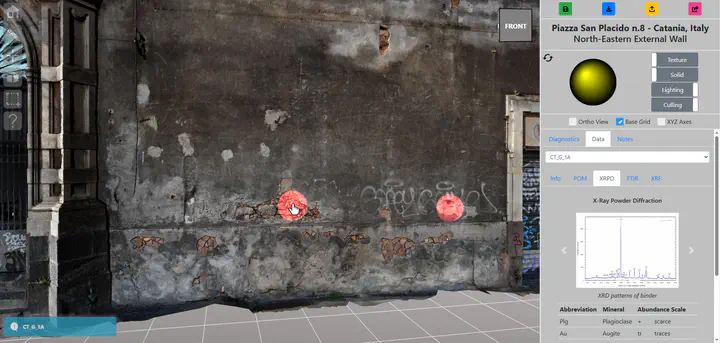
Cultural Heritage conservation increasingly relies on the integration of diverse diagnostic data acquired through multiple techniques. However, managing together these data, often heterogeneous in format and origin, remains a significant challenge. Starting from this premise, we introduce a web-based platform designed to support data fusion and visualization of multi-source diagnostic analysis. Designed by a multidisciplinary research team and developed exploiting open-source technologies, the platform enables interactive access to diagnostic results through annotated 3D models, allowing users to interrogate specific areas of interest, retrieve the associated analytical data, and share them in several ways. A key feature of the platform is its JSON-driven data management system, which associates each diagnostic analysis with a specific template composed of atomic fields easily adaptable to the requirements of various analytical methods. The platform was validated through a case study on the historic mortars of a prominent 18th-century building in Catania (Italy), a context characterized by visible degradation and partial loss of plaster, ideal for sampling and analysis. Diagnostic data were acquired using a range of techniques (including XRPD, FTIR-ATR, WD-XRF, and POM) and complemented with 3D surveying methods, resulting in a rich dataset comprising both metric and analytical information. The study confirmed that fusing heterogeneous datasets within a unified system can exemplify a data-driven approach to heritage diagnostics, while the ability to annotate models and link them to specific diagnostic entries can add a layer of semantic richness crucial for interdisciplinary interpretation.